AMI Eyes vs AMI Plus X: Which PN Booster Fits the Goal?
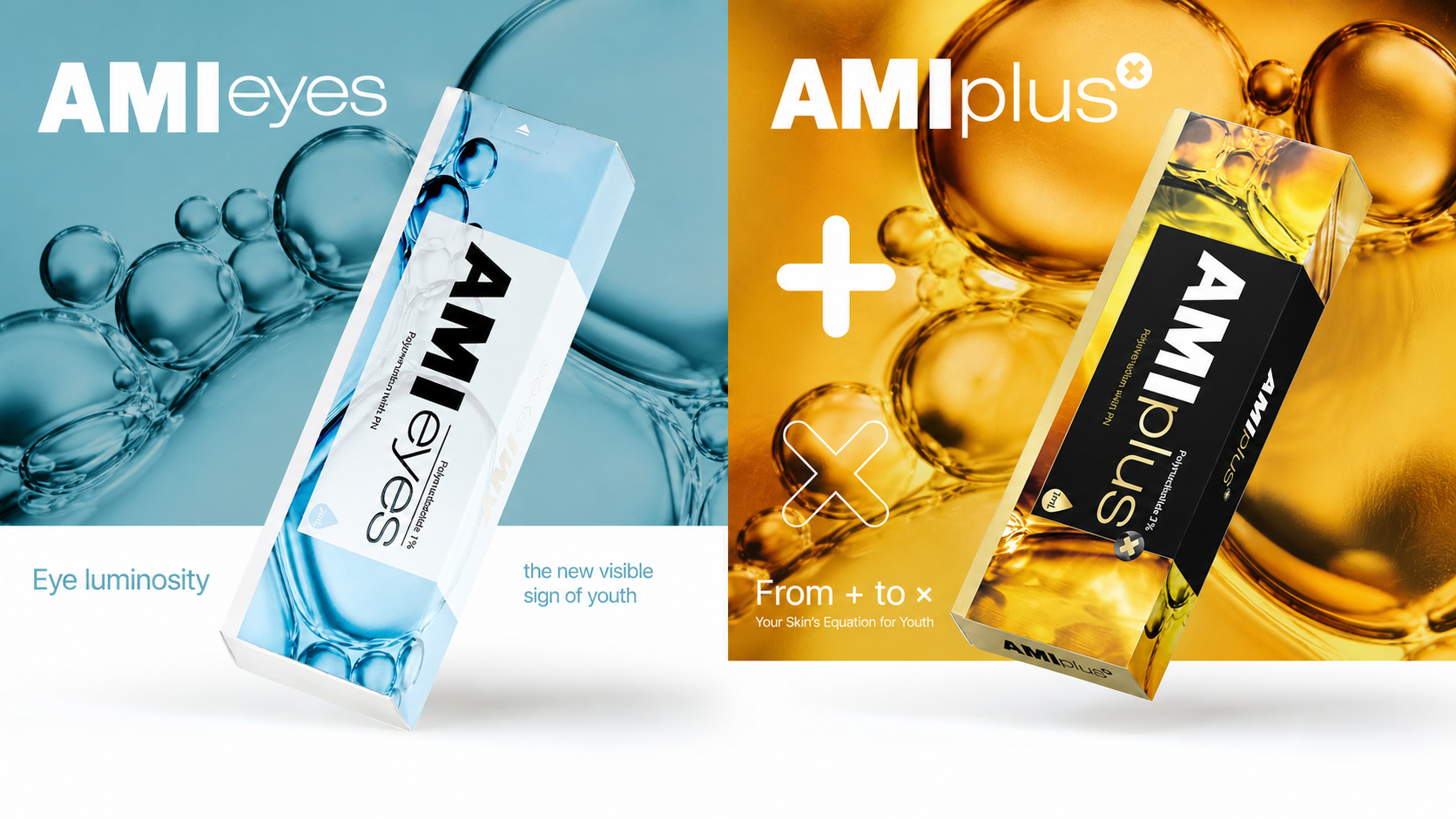
Quick answer: In the AMI Eyes vs AMI Plus X comparison, both are salmon-derived polynucleotide (PN) skin boosters, but they are positioned for different professional goals. AMI Eyes contains 1% PN (20 mg in a 2 ml syringe) and is positioned for the periorbital area. AMI Plus X contains 2% PN (40 mg in a 2 ml syringe) and is positioned for broader areas such as the face, neck and hands. Neither is universally “better.” The more appropriate option depends on the treatment area, tissue characteristics, patient assessment and the clinician’s intended objective—not concentration alone.
Searches for AMI Eyes vs AMI Plus often lead to product pages that list benefits but do not clearly separate manufacturer positioning from clinical evidence. This guide compares the verified specifications, explains what the wider PN literature can—and cannot—tell us, and gives Pakistan-based professionals a practical way to discuss the two products without turning a higher percentage into an automatic recommendation.
AMI Eyes vs AMI Plus X at a glance
- AMI Eyes: 1% PN, 20 mg total in 2 ml, positioned for the periorbital area.
- AMI Plus X: 2% PN, 40 mg total in 2 ml, positioned for broader facial and body areas, including the face, neck and hands.
- The central difference: intended treatment-area positioning and PN concentration.
- The evidence limit: broader PN research is promising but heterogeneous and does not prove that one of these AMI products will outperform the other.
- The selection principle: match the product to the assessed area and clinical objective through a qualified professional.
| Comparison point | AMI Eyes | AMI Plus X |
|---|---|---|
| Product category | Polynucleotide skin booster | Polynucleotide skin booster |
| PN concentration | 1% PN | 2% PN |
| PN amount | 20 mg total | 20 mg/ml; 40 mg total |
| Pack volume | 1 × 2 ml prefilled syringe | 1 × 2 ml prefilled syringe |
| Manufacturer positioning | Targeted periorbital/eye-area use | Broader-area use, including face, neck and hands |
| DNA source stated by brand | Purified salmon-derived DNA | Purified salmon-derived DNA |
| Professional selection question | Is the assessed goal specifically centred on the delicate eye area? | Is the assessed goal broader skin-quality support outside an eye-specific indication? |
| What the table does not establish | It does not establish superior outcomes, an individual indication, a treatment schedule or suitability for a particular patient. | |
What are polynucleotide skin boosters?
Polynucleotides are chains of nucleotides—the building blocks associated with DNA. In aesthetic medicine, purified polynucleotide materials are used in injectable products intended to support skin-quality goals. They are commonly discussed in relation to hydration, texture, elasticity and the appearance of fine lines. However, those are research and treatment objectives, not guaranteed outcomes for every product or patient.
PN products are not the same as conventional volumising dermal fillers. A filler is generally selected when structural support, contour or volume is the main objective. PN treatments are more often framed around skin quality and tissue environment. The distinction matters because calling every injectable a “filler” can create the wrong expectation about what the product is designed to do.
PN vs PDRN: related terms, not exact synonyms
Polynucleotides (PN) and polydeoxyribonucleotide (PDRN) both refer to purified DNA-derived materials, and marketing language sometimes uses the terms loosely. A 2025 review describes PN as relatively longer DNA fragments and PDRN as relatively shorter oligonucleotide sequences. It also notes that the two materials overlap conceptually but should not automatically be treated as identical. Read the PN and PDRN review on PubMed.
This distinction is especially important when discussing mechanism. Pathways associated with PDRN—including adenosine A2A receptor signalling and nucleotide salvage—are frequently referenced in the wider literature. That does not mean every proposed PDRN pathway has been directly demonstrated for every commercial PN formulation.
How might PN support skin quality?
The short version is that several biological explanations are plausible, while the complete mechanism in aesthetic skin use remains under investigation. Reviews discuss interactions with the extracellular environment, fibroblast-related activity, hydration and tissue-repair signalling. Yet the 2024 review of PN practice explicitly states that the mechanism is not fully established and that some explanations are extrapolated from PDRN research. See the open-access 2024 review.
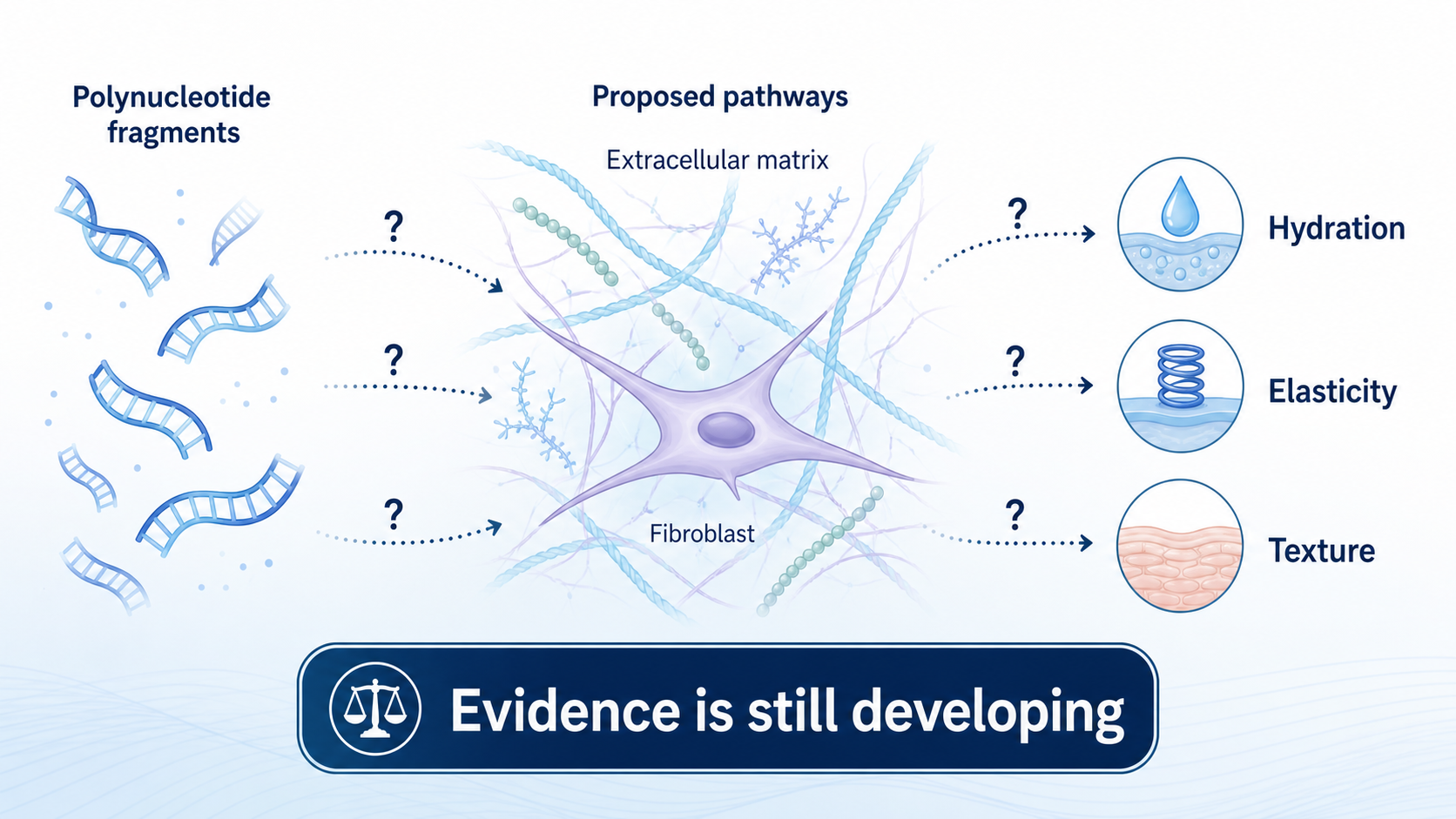
That evidence boundary should shape how AMI Eyes and AMI Plus X are discussed. Product concentration and manufacturer positioning are verifiable facts. The wider literature can explain why PN is being studied. But a broad PN study cannot establish the clinical performance of a named AMI product unless that formulation was actually evaluated.
What is AMI Eyes?
AMI Eyes is a 1% PN skin booster presented in one 2 ml prefilled syringe. The brand states a total PN content of 20 mg and positions the product for the periorbital area. It is manufactured by Quiver Medic and described as using purified salmon-derived DNA.
The important word is positioned. An eye-area product may be relevant when a qualified practitioner is evaluating skin-quality concerns around the eyes, but the product name alone does not diagnose the concern or establish suitability. Under-eye shadowing, hollowness, pigmentation, fluid-related puffiness and textural change can look similar to a consumer while requiring very different professional thinking.
AMI Eyes should therefore be understood as the more targeted product in this comparison: lower PN concentration, the same 2 ml presentation, and an eye-specific manufacturer position. It should not be described as a cure for dark circles, eye bags or all forms of periocular ageing.
What is AMI Plus X?
AMI Plus X—often shortened in searches to “AMI Plus”—is a 2% PN skin booster presented in one 2 ml prefilled syringe. The brand states 20 mg/ml, or 40 mg total, and positions it for broader areas including the face, neck and hands. It is also manufactured by Quiver Medic and described as using purified salmon-derived DNA.
AMI Plus X is therefore the broader-area, higher-concentration option on the verified specifications. That does not make it a universal upgrade from AMI Eyes. Products intended for different tissues and objectives should not be ranked on percentage alone. A professional assessment still needs to consider the anatomical area, skin condition, medical history, product documentation and the person’s expectations.
The key differences in practical terms
1. Treatment-area positioning
The clearest difference is where each product is positioned for use. AMI Eyes is specifically associated with the periorbital area. AMI Plus X is associated with broader skin-quality goals across areas such as the face, neck and hands. This is a positioning distinction, not a recommendation to use either product in every named area.
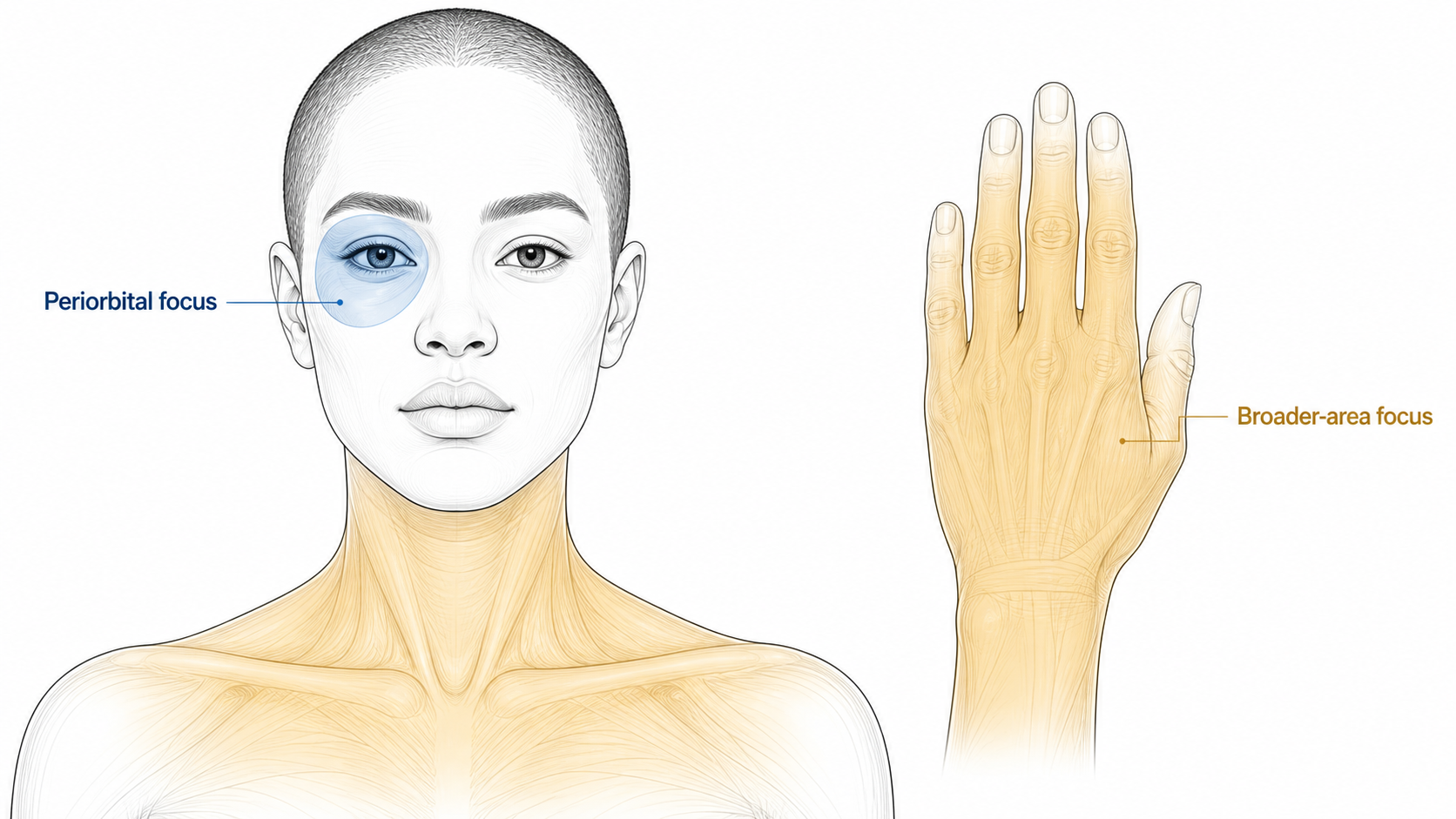
2. PN concentration and total amount
AMI Eyes contains 1% PN and 20 mg total. AMI Plus X contains 2% PN and 40 mg total. Because both are supplied as 2 ml, the difference is easy to understand numerically. It is not enough to predict comparative results. Concentration is one formulation variable; appropriate product selection also depends on the area, product characteristics, practitioner judgement and patient factors.
3. The clinical objective being assessed
An eye-specific conversation may centre on fine periocular texture, hydration or skin quality. A broader-area conversation may centre on facial, neck or hand skin quality. These are not diagnoses, and they do not mean the product will correct unrelated structural, pigmentary or vascular causes of an appearance concern.
4. The evidence available
We did not identify a peer-reviewed, head-to-head clinical trial comparing AMI Eyes with AMI Plus X. The most responsible comparison therefore starts with confirmed product specifications and uses PN research only as category-level context. Claims that one AMI product “works faster,” “lasts longer” or produces a particular percentage improvement would require direct supporting data.
Which one may fit different professional goals?
If the assessed goal is specifically periorbital: AMI Eyes is the product explicitly positioned for that area. That makes it the more directly aligned option to discuss with an appropriately qualified practitioner. It does not mean every under-eye concern is a PN indication.
If the assessed goal concerns broader facial, neck or hand skin quality: AMI Plus X is the product positioned for those broader areas and provides the higher stated PN concentration. Again, positioning and concentration do not substitute for patient selection.
If the question is simply “which is stronger?” AMI Plus X has the higher PN concentration and total PN amount. “Stronger,” however, is not the same as more suitable, safer or more effective for a particular person or anatomical area.
If the main concern is volume loss, deep structural change, pigmentation or vascular shadowing: a PN comparison may be the wrong starting point. A clinician first needs to identify what is contributing to the visible concern and then discuss suitable categories of care.
Is there a best polynucleotide skin booster?
There is no evidence-based universal winner. “Best” is conditional on the treatment objective, anatomical area, formulation, product authenticity, practitioner experience, patient history and the quality of evidence for the claim being made. A product with a higher PN percentage is not automatically the best product for delicate tissue, and an eye-positioned product is not automatically the right response to every under-eye complaint.
A better question is: Which documented product characteristics fit the assessed concern, and what evidence supports the expected outcome? That approach is more useful than comparing concentration, brand popularity or price in isolation.
What does the clinical research actually show?
| Source | What it examined | Main signal | Why caution is needed |
|---|---|---|---|
| 2024 aesthetic PN review | Current practices and reported effectiveness across aesthetic use | Potential improvements in texture, wrinkles and facial appearance were reported, with variable findings | The literature was heterogeneous; some studies found limited or no benefit, and more research was requested |
| 2025 systematic review | Nine studies involving 219 participants | Promising signals for wrinkles, texture and elasticity | Overall evidence quality was low to moderate, with variation in areas, products, techniques and outcomes |
| Randomised split-face periocular study | PN compared with non-crosslinked hyaluronic acid in 27 participants | No significant difference in visual or global aesthetic scores; some instrument-measured hydration, elasticity and texture measures favoured PN over time | Small study, comparator-specific and not an AMI Eyes trial; it cannot establish performance for the AMI formulation |
| 2021 PN-HPT expert consensus | Expert experience across facial and body areas | Described practical use across the face, periocular region, neck and hands | Consensus and product-technology specific; not a randomised comparison of AMI products, and conflicts of interest were disclosed |
The 2025 systematic review is the most useful summary signal: it found nine eligible studies with 219 patients and judged the available evidence low to moderate in quality. The findings support continued clinical research, not certainty. Small samples, inconsistent outcome measures, different formulations and varied techniques make it difficult to estimate how much improvement an individual should expect.
The periocular split-face trial is relevant because it studied the eye area, but it still should not be used as proof for AMI Eyes. It evaluated a specific PN material in a small group and compared it with a specific non-crosslinked hyaluronic acid product. Product-level evidence does not transfer automatically across brands or formulations.
A professional way to compare the two products
A responsible consultation should move through the following questions before it reaches a product name:
- What is the main concern? Texture, hydration, laxity, pigmentation, hollowness and puffiness are not interchangeable.
- Which anatomical area is being assessed? Periorbital tissue has different characteristics from the cheek, neck or hand.
- What does the product documentation actually state? Concentration, volume, intended positioning, manufacturer, batch details and storage matter.
- What is known about the patient? Medical history, previous procedures, current medicines, allergies and expectations can change the discussion.
- How strong is the evidence for the claim? Category-level research, expert consensus and product-specific trials are different evidence levels.
- Can authenticity and supply be documented? Professional products should have traceable sourcing and appropriate handling.
This framework avoids the common mistake of selecting a product first and trying to fit every concern around it.
Safety, suitability and realistic expectations
Both AMI products are professional-use injectables. They should be assessed and administered only by an appropriately qualified healthcare professional working within local rules and their scope of practice. This guide does not provide injection technique, dosing, treatment intervals or individual medical advice.
Any injectable procedure can involve unwanted effects and local reactions. The periorbital area requires particular anatomical care. Because the products are described as salmon-DNA-derived, the source should also be part of the clinician’s medical-history and allergy discussion. Patients should disclose previous aesthetic procedures, allergies, medicines, pregnancy or breastfeeding status, active skin problems and relevant health conditions to their treating professional.
Realistic consent also means separating possible skin-quality improvement from promises. The current PN literature is encouraging, but it does not justify guaranteed transformation, a fixed duration of effect or a claim that every under-eye concern will improve.
Product authenticity and professional supply in Pakistan
AMI’s product pages describe a HiddenTag authenticity feature. That is useful, but professional procurement should still include a documented supply path, intact packaging, batch and expiry checks, and storage information. Buyers should not rely on a low price or a social-media image as proof of authenticity.
NEES Medical lists both products in its clinical catalogue for professional inquiry in Pakistan:
- View AMI Eyes 1% PN, 1 × 2 ml
- View AMI Plus X 2% PN, 1 × 2 ml
- Browse the professional booster catalogue
- Request current professional pricing and availability
Availability, documentation and professional pricing may change, so use the current inquiry route rather than treating an older article or search snippet as live stock confirmation.
Related comparisons and learning
For broader category context, compare this guide with the LapuroN Aurora PDRN buying guide and the LapuroN Aurora Super PDRN clinic guide. For eye-area category comparisons outside AMI, see the Jalupro Young Eye guide and RejUveyes eye product guide. These products use different formulations and should not be treated as direct equivalents.
Frequently asked questions
What is the main difference between AMI Eyes and AMI Plus X?
AMI Eyes contains 1% PN, 20 mg total in 2 ml, and is positioned for the periorbital area. AMI Plus X contains 2% PN, 40 mg total in 2 ml, and is positioned for broader areas such as the face, neck and hands.
Is AMI Plus X better than AMI Eyes because it contains 2% PN?
No. It has a higher PN concentration, but concentration alone does not determine suitability or clinical outcome. The anatomical area, treatment objective, formulation, patient assessment and professional judgement all matter.
Is AMI Eyes only for dark circles?
No. It is positioned for the periorbital area, but “dark circles” can have pigmentary, vascular, structural or shadow-related causes. A product name cannot identify the cause, and AMI Eyes should not be presented as a universal dark-circle treatment.
Can AMI Plus X be used under the eyes?
This guide cannot recommend an individual treatment area. AMI Eyes is the AMI product specifically positioned for the periorbital region, while AMI Plus X is positioned for broader areas. A qualified professional must work from current product documentation and a patient assessment.
Are AMI Eyes and AMI Plus X dermal fillers?
They are marketed as PN skin boosters, not conventional volumising dermal fillers. PN treatments are generally discussed around skin-quality goals rather than structural volume replacement.
What is the difference between PN and PDRN?
They are related DNA-derived materials, but not exact synonyms. Current reviews describe PN as relatively longer DNA fragments and PDRN as relatively shorter oligonucleotide sequences. Mechanisms established for one material should not automatically be assigned to every product in the other category.
How quickly do polynucleotide treatments work?
The current literature is too heterogeneous to give one reliable timeline for every product and patient. Formulations, treatment areas, outcome measures and study designs differ. Product-specific expectations should be discussed by the treating professional.
How long do AMI Eyes or AMI Plus X results last?
We did not identify robust product-specific comparative evidence that establishes a fixed duration for these two products. Avoid any guaranteed duration quoted without supporting product-level data.
Are polynucleotide skin boosters clinically proven?
Human studies and reviews report promising skin-quality signals, but a 2025 systematic review found only nine eligible studies involving 219 patients and rated the evidence low to moderate in quality. More rigorous, standardised trials are needed.
Has AMI Eyes been clinically compared with AMI Plus X?
We did not identify a peer-reviewed head-to-head clinical trial of AMI Eyes versus AMI Plus X. The comparison in this guide is based on verified product specifications, manufacturer positioning and wider PN research—not a claim of comparative efficacy.
Who should choose between AMI Eyes and AMI Plus X?
An appropriately qualified healthcare professional should assess the concern, medical history, anatomical area, product documentation and expectations before deciding whether either product is suitable.
Where can professionals inquire about AMI products in Pakistan?
Professionals can use the NEES Medical clinical booster catalogue and pricing inquiry page to ask about current availability, professional pricing and documentation.
Bottom line
The evidence-informed answer to AMI Eyes vs AMI Plus X is not that one product wins. AMI Eyes is the 1% PN, eye-positioned option; AMI Plus X is the 2% PN, broader-area option. Those specifications help frame a professional discussion, but they do not predict an individual result. Match the documented product positioning to the assessed concern, verify authenticity and supply, and keep expectations aligned with a PN evidence base that remains promising but incomplete.
Medical disclaimer: This article is for professional and educational information only. It is not a diagnosis, prescription, injection guide or substitute for assessment by an appropriately qualified healthcare professional. Product availability and documentation should be verified at the time of inquiry.
Frequently Asked Questions
What is the main difference between AMI Eyes and AMI Plus X?
AMI Eyes contains 1% PN, 20 mg total in 2 ml, and is positioned for the periorbital area. AMI Plus X contains 2% PN, 40 mg total in 2 ml, and is positioned for broader areas such as the face, neck and hands.
Is AMI Plus X better than AMI Eyes because it contains 2% PN?
No. It has a higher PN concentration, but concentration alone does not determine suitability or outcome. The anatomical area, treatment objective, formulation, patient assessment and professional judgement all matter.
Is AMI Eyes only for dark circles?
No. It is positioned for the periorbital area, but dark circles can have pigmentary, vascular, structural or shadow-related causes. A product name cannot identify the cause.
Can AMI Plus X be used under the eyes?
This guide cannot recommend an individual treatment area. AMI Eyes is specifically positioned for the periorbital region, while AMI Plus X is positioned for broader areas. A qualified professional must use current documentation and patient assessment.
Are AMI Eyes and AMI Plus X dermal fillers?
They are marketed as PN skin boosters, not conventional volumising dermal fillers. PN treatments are generally discussed around skin-quality goals rather than structural volume replacement.
What is the difference between PN and PDRN?
They are related DNA-derived materials, but not exact synonyms. Reviews describe PN as relatively longer DNA fragments and PDRN as relatively shorter oligonucleotide sequences.
How quickly do polynucleotide treatments work?
The literature is too heterogeneous to give one reliable timeline for every product and patient. Formulations, areas, outcomes and study designs differ.
How long do AMI Eyes or AMI Plus X results last?
Robust product-specific comparative evidence does not establish a fixed duration for these two products. Avoid guaranteed duration claims without supporting product-level data.
Are polynucleotide skin boosters clinically proven?
Human studies report promising signals, but a 2025 systematic review found only nine eligible studies involving 219 patients and rated the evidence low to moderate in quality.
Has AMI Eyes been clinically compared with AMI Plus X?
We did not identify a peer-reviewed head-to-head trial. This guide compares verified specifications, manufacturer positioning and wider PN research—not comparative efficacy.

About NEES Medical

Latest Posts